
Kaspa: The True Implementation of Satoshi’s Whitepaper for 8 Billion Users
Kaspa: The True Implementation of Satoshi’s Whitepaper for 8 Billion Users
October 5, 2025. On this day, something remarkable happened that most of the world didn’t notice. While Bitcoin celebrated its status as digital gold and Ethereum continued its march toward becoming the world computer, a relatively unknown cryptocurrency called Kaspa quietly processed more than 158 million transactions in a single day—nearly matching Bitcoin’s entire yearly transaction volume in just 24 hours.
This wasn’t a theoretical benchmark. It wasn’t a testnet experiment. It was real-world throughput on a live, decentralized, proof-of-work blockchain that demonstrated what Satoshi Nakamoto’s vision could look like when scaled for global adoption.
The question isn’t whether cryptocurrency can serve 8 billion people. The question is: which cryptocurrency can actually do it?
The Numbers Don’t Lie: A Performance Reality Check
Let’s cut through the marketing hype and look at what different networks can actually handle in terms of transactions per second (TPS):
At first glance, Visa still appears to be the king. But here’s what the raw numbers don’t tell you: Visa operates through a centralized network of banks and payment processors. Kaspa achieves its throughput through a fully decentralized, proof-of-work consensus mechanism—the same security model that Bitcoin pioneered.
And unlike other high-speed cryptocurrencies that sacrifice decentralization or security to achieve scale, Kaspa maintains sub-second finality with transaction fees consistently below $0.001. Transaction fees on Kaspa remained below $0.001 per transfer, making it one of the most cost-efficient Layer 1 networks currently operating.
The Crescendo Upgrade: From 1 BPS to 10 BPS
Kaspa didn’t achieve these results by accident. In May 2025, the network underwent the Crescendo hard fork, which increased its block production rate from 1 block per second (BPS) to 10 blocks per second. This seemingly simple change had profound implications for throughput.
The network’s blockDAG architecture—which allows multiple blocks to be produced simultaneously and incorporated into the ledger rather than discarded as “orphans”—means that increasing block production directly translates to increased transaction capacity.
Following the Crescendo hardfork earlier in 2025, Kaspa’s block rate increased from one block per second to ten blocks per second, drastically boosting throughput. The result? A network capable of processing millions of transactions per day with minimal fees and near-instant finality.
On that record-breaking day in October 2025, Kaspa’s network also hit 5,705 transactions per second, setting a benchmark that no other proof-of-work blockchain has matched.
Bitcoin’s Historical Context: The Scalability Reality
To understand why Kaspa’s achievement matters, we need to examine Bitcoin’s limitations with real data.
Bitcoin reached its all-time high for daily transactions on April 30, 2023, with 568,300 confirmed transactions in a single 24-hour period. This was during a period of intense network congestion driven by Ordinals inscriptions and BRC-20 tokens.
According to data from YCharts and Glassnode, Bitcoin handled about 160 million transactions between October 2024 and October 2025. Over an entire year, Bitcoin processed 160 million transactions. Kaspa matched that number in one day.
During peak congestion periods, Bitcoin’s limitations become painfully obvious. In April 2024, following the halving event, average Bitcoin transaction fees spiked to $91.89—a staggering increase from just $3.35 the previous month. Such spikes are not anomalies—they’re the inevitable result of limited block space meeting high demand. While fees have since normalized, this volatility makes Bitcoin impractical as a medium of exchange for everyday transactions.
The 38-Year Problem: Bitcoin’s Adoption Timeline
Here’s where the mathematics become sobering.
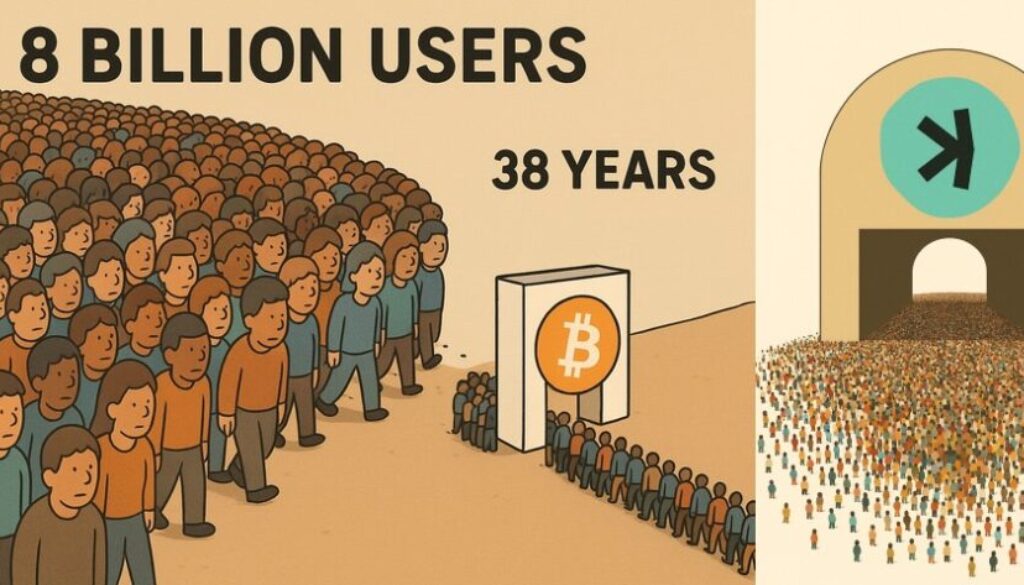
Let’s assume 8 billion people want to use Bitcoin as a payment system. Let’s further assume they’re not competing with each other through fee bidding but are instead paying minimum network fees. Let’s use Bitcoin’s best-ever day—568,300 transactions on April 30, 2023—as the benchmark for what the network can handle.
The calculation:
8,000,000,000 users ÷ 568,300 transactions per day = 14,077.071 days
14,077.071 days ÷ 365 days per year = 38.567 years
Even under the most optimistic scenario—where every single day matches Bitcoin’s all-time peak transaction volume and users aren’t competing through higher fees—it would take 38 years, 6 months, and 24 days just to onboard 8 billion users with a single transaction each.
This doesn’t account for:
Users making multiple transactions
Fee competition during high-demand periods
Network congestion causing delays exceeding 60 minutes
The exponential increase in fees as demand grows
This is not a path to global adoption. It’s a mathematical impossibility.
The 50-Day Solution: Kaspa’s Adoption Timeline
Now let’s run the same calculation with Kaspa’s proven throughput from October 5, 2025.
The calculation:
8,000,000,000 users ÷ 158,000,000 transactions per day = 50.632 days
At Kaspa’s demonstrated real-world performance, onboarding 8 billion users with one transaction each would take 50 days and 15 hours.
Not 38 years. Not 38 months. 50 days.
And this assumes the network maintains its October 5th throughput without the planned upgrades to 100 blocks per second, which would reduce that timeframe to approximately 5 days.
The Lightning Network Caveat
Bitcoin maximalists often point to the Lightning Network as the solution to Bitcoin’s scalability problems. And they’re not entirely wrong—Lightning enables fast, cheap off-chain transactions that settle on the Bitcoin base layer.
But here’s the critical issue: Lightning Network Bitcoin cannot be stored on hardware wallets in the traditional sense and is not as user-friendly as the base layer.
Lightning requires:
Channels to be opened and closed (both requiring on-chain transactions and fees)
Liquidity to be managed
Nodes to be online for receiving payments
Technical knowledge that exceeds what average users possess
Trust in channel partners or reliance on custodial solutions
For the average person—particularly those in developing nations who need cryptocurrency most—Lightning adds layers of complexity that make Bitcoin less accessible, not more. It’s a band-aid on a fundamental architectural limitation, not a true solution.
Kaspa’s base layer provides the speed and efficiency that Lightning promises, without the complexity or compromises.
Comparing On-Chain Performance Per Active User
A critical insight often overlooked in cryptocurrency comparisons is on-chain throughput per active user. Raw TPS numbers can be misleading if a network has billions of dollars backing it but relatively few actual users, versus a smaller network serving a massive user base efficiently.
Consider this perspective: Kaspa is outperforming Visa in terms of throughput per network scale and user base. While Visa processes more absolute volume (they have decades of infrastructure and billions of users), Kaspa achieves comparable per-user efficiency without banks, with proof-of-work security, and with fees under $0.001.
Kaspa processed over 158 million transactions in one day (October 5, 2025), nearly matching Bitcoin’s yearly total, while maintaining decentralization and security standards that match or exceed Bitcoin’s model.
This isn’t about being “better than Visa” in total volume—yet. It’s about demonstrating superior performance relative to network scale, user base, and security model. As adoption grows, Kaspa’s architecture is built to scale linearly, while Bitcoin’s architecture faces exponential congestion.
Bitcoin’s Three Fatal Flaws for Mass Adoption
Kaspa solves the three critical problems that prevent Bitcoin from serving as global peer-to-peer electronic cash:
1. Prohibitive Fees During High Demand
Bitcoin’s limited block space creates a fee market where users must bid against each other for transaction inclusion. During the April 2024 halving event, fees spiked to nearly $92 per transaction. Even moderate congestion can push fees above $10-$20, making small transactions economically unfeasible.
Kaspa’s solution: With 10 blocks per second and blockDAG architecture that eliminates orphaned blocks, network capacity expands with demand. Fees remain below $0.001 even during peak usage because there’s no artificial scarcity of block space.
2. Unacceptable Waiting Times
Bitcoin’s 10-minute block time means even a simple coffee purchase requires waiting potentially hours for confirmation if you want security equivalent to 6 confirmations (60+ minutes). During high congestion, unconfirmed transactions can sit in the mempool for days.
Kaspa’s solution: Transactions reach finality within 7 seconds. No waiting. No anxiety about whether your payment will clear. Just instant, final settlement.
3. Impossible to Scale to 8 Billion Users
As demonstrated above, Bitcoin’s architecture cannot onboard a meaningful fraction of humanity in any reasonable timeframe. The waiting time and confirmation delays create a bottleneck that prevents Bitcoin from being used as a medium of exchange at global scale.
Kaspa’s solution: Real-world demonstration of 158 million daily transactions proves the network can handle mass adoption. With planned upgrades to 100 BPS, Kaspa could theoretically process over 1 billion transactions per day.
The Philosophical Core: Own & Use, Then Understand
There’s a core principle often repeated in Bitcoin circles: “If you don’t own Bitcoin, it’s because you don’t understand it.”
This is true. Bitcoin’s value as a store of value, a hedge against monetary debasement, and a neutral settlement layer is undeniable once you understand its properties.
But we need to add a corollary for the next generation of cryptocurrency adoption:
“Own & Use, then Understand.”
The 8 billion people who need cryptocurrency most—those in countries with high inflation, weak property rights, limited banking access, or oppressive financial surveillance—don’t have time for a 38-year onboarding period. They don’t want to manage Lightning channels. They don’t want to pay $20 fees to send $50 to their family.
They need a system they can own immediately and use immediately, with the understanding following from successful real-world experience.
Kaspa provides this. Own your KAS. Use it to make instant, nearly-free transactions. Understand, through direct experience, what peer-to-peer electronic cash actually means.
Proof-of-Work: The Non-Negotiable Security Standard
One of Kaspa’s most important features is what it doesn’t compromise: security.
Unlike Solana, Sui, or other high-speed chains that achieve throughput through proof-of-stake mechanisms with relatively small validator sets, Kaspa maintains Bitcoin’s proof-of-work security model. The network is secured by computational power distributed across thousands of independent miners, not by staked tokens that can be slashed or governance that can be captured.
Kaspa remains a Proof-of-Work network, securing transactions through the kHeavyHash algorithm, which is optimized for energy efficiency while maintaining the decentralization and security properties that made Bitcoin revolutionary.
This matters because proof-of-work is the only consensus mechanism that has been battle-tested at global scale for over 15 years. It’s the only mechanism that provides true permissionless participation—anyone can mine without permission from validators, foundations, or token holders.
Kaspa proves you don’t have to choose between proof-of-work security and high throughput. You can have both.
The BlockDAG Architecture: Satoshi’s Paradigm Extended
The reason Kaspa can achieve what Bitcoin cannot isn’t because it abandons Satoshi’s principles—it’s because it extends them.
Traditional blockchains face a fundamental trade-off: increase block production rate, and you increase orphaned blocks (blocks that are produced simultaneously but discarded because only one can be added to the chain). This wasted computational power and increased centralization pressure (because miners with better connectivity have an advantage).
Bitcoin chose slow block times (10 minutes) to minimize orphans. This preserved decentralization but sacrificed throughput.
Kaspa’s blockDAG architecture eliminates orphan blocks entirely. When multiple blocks are produced simultaneously, they’re all incorporated into the ledger. The GHOSTDAG consensus protocol then determines transaction ordering through a sophisticated weighting mechanism that maintains security while enabling parallelization.
Kaspa’s blockDAG design allows multiple blocks to be created in parallel, enabling it to process millions of transactions per second — far more than Bitcoin’s linear chain.
This isn’t a rejection of Nakamoto Consensus—it’s a generalization of it. The same incentive structures, the same proof-of-work security, the same permissionless participation—just freed from the artificial constraint of linear block production.
Real-World Adoption Signals
Kaspa’s theoretical advantages are impressive, but what matters is real-world adoption. Here are the signals that institutional and retail users are taking notice:
Network active addresses surged 150% year-over-year to 545,600
Over 700 public nodes globally contributing to decentralization
94% of max supply already mined through fair distribution (no pre-mine, no ICO)
Developer Activity:
K Social, an on-chain social platform, demonstrates real-world use cases, similarly to X.
Kasplex, Layer 2 development for smart contracts and DeFi
Igra Labs, Layer 2 development for smart contracts and DeFi
KaspPathon hackathon with 200,000 KAS in prizes to foster ecosystem growth
Institutional Interest:
Marathon Digital (a major Bitcoin mining company) allocated resources to mine Kaspa
$35 million in whale accumulation reported in November 2025
Growing exchange listings on major platforms including HTX, MEXC, Bybit, Gate.io
Market Validation:
Market cap reached $1.18 billion by late 2025
Daily trading volume averaging $74 million
Stock-to-flow ratio crossed 20, approaching silver’s scarcity level
These aren’t the metrics of a speculative token. They’re the indicators of a maturing network gaining real utility.
The October 5th Stress Test: When Exchanges Couldn’t Keep Up
The 158 million transaction day wasn’t just a milestone—it was an inadvertent stress test that revealed something important: Kaspa’s network didn’t break. The infrastructure around it couldn’t keep up.
Several exchanges, including Bitget, ViaBTC, ProBit Global, and MEXC, temporarily suspended Kaspa deposits and withdrawals after October 5th. Critics immediately assumed this was a network failure.
It wasn’t.
Kaspa just processed 158 million transactions in 24 hours — a world record. The network kept running smoothly. But several ecosystem partners (like wallets and exchanges) temporarily paused services.
The issue was that exchange infrastructure—designed to handle typical cryptocurrency volumes—couldn’t reconcile 158 million transactions fast enough. The blockchain itself never stopped, never slowed down, never dropped transactions. The exchanges’ databases couldn’t process the incoming data stream.
As one analyst explained: “Kaspa didn’t break, it outpaced the existing infrastructure. The network moved faster than the ecosystem could record it.”
This is actually a bullish signal. It means the base layer protocol is already production-ready for global scale. The ecosystem just needs to catch up.
In response, Kaspa launched the Kaspa Ecosystem Resilience Task Force to help partners optimize their systems for high-volume throughput. This is how mature networks evolve—by identifying bottlenecks and systematically addressing them.
Elon Musk’s Vision: Energy as the New Currency
In November 2025, Elon Musk appeared on the WTF podcast with Indian entrepreneur Nikhil Kamath and made a statement that reverberated through both the cryptocurrency and energy sectors: “Energy is the true currency. Bitcoin is based on energy.“
Musk’s thesis is straightforward but profound: in a future where artificial intelligence and robotics can satisfy all human needs, traditional money loses its relevance. “In a future where anyone can have anything, you no longer need money as a database for labor allocation,” he explained.
But what remains valuable in such a post-scarcity world? Energy.
“You can’t legislate energy. You can’t just pass a law and suddenly have a lot of energy,” Musk emphasized, drawing a clear distinction between fiat currency (which governments can print at will) and energy (which is bound by the laws of physics). He called energy generation “a fundamental expression of value” because unlike money, energy cannot be created arbitrarily.
Why This Matters for Proof-of-Work Cryptocurrencies
Musk’s framework positions proof-of-work cryptocurrencies like Bitcoin—and by extension, Kaspa—as the first monetary systems fundamentally tied to physics rather than politics. By requiring real energy expenditure to mine and secure the network, these cryptocurrencies convert electricity into digital value, creating what Musk called “a fundamental physics-based currency.”
But here’s where Kaspa’s advantage becomes critical: in Musk’s energy-centric future, efficiency matters enormously.
If energy is the true currency, then cryptocurrencies must use it wisely. Bitcoin’s 10-minute block times and limited throughput mean significant energy expenditure for relatively few transactions—about 7 per second. Kaspa, with its blockDAG architecture, processes thousands of transactions per second while maintaining the same proof-of-work security model.
Put another way: Kaspa converts energy into utility far more efficiently than Bitcoin, without sacrificing decentralization or security.
AI Agents and Real-Time Decentralized Payments
Musk’s prediction that AI and robotics will become sophisticated enough to handle most production autonomously has another implication: AI agents will need to transact with each other in real-time.
Machine-to-machine payments cannot tolerate Bitcoin’s 60-minute confirmation times. An AI managing supply chains, negotiating compute resources, or coordinating logistics needs instant, trustless settlement. Kaspa’s sub-10-second finality makes it viable for this use case in ways that Bitcoin simply cannot be.
As the world moves toward what Musk describes as an age of abundance powered by AI, the cryptocurrency that serves as the settlement layer for autonomous agents must be:
Energy-efficient (maximizing utility per unit of energy spent)
Fast (no waiting periods that create bottlenecks)
Economical (fees low enough for micropayments and frequent transactions)
Proof-of-work secured (trusted, permissionless, and resistant to capture)
Kaspa checks all four boxes. Bitcoin checks only the last one.
In Musk’s vision of the future, where “power generation becomes the de facto currency” and AI systems require instant settlement, Kaspa’s architecture represents not just an improvement over Bitcoin—it represents the necessary infrastructure for the post-scarcity economy he describes.
Energy is the new currency. And only efficient, economic proof-of-work that can fuse energy into a global network with real-time decentralization will serve as the trusted internet currency for daily use as payment—and for the AI agents that will drive the next economic revolution.
The Visionaries Behind Kaspa
Dr. Yonatan Sompolinsky: The Academic Pioneer
Kaspa’s existence is inseparable from the groundbreaking research of Dr. Yonatan Sompolinsky, an Israeli computer scientist whose work has influenced the entire cryptocurrency industry.
Academic Foundation: Sompolinsky earned his Ph.D. in computer science from the Hebrew University of Jerusalem in 2018, studying under Professor Aviv Zohar. Following his doctorate, he conducted postdoctoral research at Harvard University, focusing on blockchain scalability, transaction ordering, and miner extractable value (MEV).
The GHOST Protocol (2013): Sompolinsky first gained recognition in 2013 when he and Professor Zohar proposed the GHOST (Greedy Heaviest Observed Sub-Tree) protocol. GHOST was famous for being cited in the Ethereum whitepaper as a design goal, demonstrating its influence on Vitalik Buterin’s thinking about how to scale blockchain consensus.
GHOST addressed Bitcoin’s orphan block problem by changing how the network selects the “main chain”—instead of just following the longest chain, GHOST considers the entire subtree of blocks, allowing faster block production without compromising security.
The SPECTRE Protocol (2016): Building on GHOST, Sompolinsky and Zohar published the SPECTRE consensus algorithm, which was specifically designed for DAG-based systems. SPECTRE showed that transactions could be ordered in a directed acyclic graph structure while maintaining security guarantees, laying the conceptual groundwork for what would become Kaspa.
PHANTOM and GHOSTDAG: The culmination of Sompolinsky’s research came in 2018 with the publication of “PHANTOM GHOSTDAG: A Scalable Generalization of Nakamoto Consensus.” This paper formalized the mathematical proofs that a blockDAG structure could maintain Bitcoin’s security properties while dramatically increasing throughput.
The GHOSTDAG protocol solves the ordering problem in DAGs by scoring blocks based on their connectivity and creating a k-cluster structure where honest blocks naturally group together. This eliminates the need to discard orphan blocks, allowing parallel block production without compromising security.
Founding Kaspa (2021): After years of theoretical work, the cryptocurrency community began asking Sompolinsky when he would launch a real-world implementation. On November 7, 2021, Sompolinsky founded KASPA, a layer 1 blockchain that operates on a proof-of-work system and incorporates the PHANTOM/GHOSTDAG protocol, using a Directed Acyclic Graph (DAG).
Critically, Kaspa launched fairly—no pre-mine, no ICO, no venture capital allocations. It was a pure proof-of-work launch that honored the principles Satoshi embedded in Bitcoin.
Ongoing Research: Sompolinsky continues to push the boundaries of blockchain technology. He’s currently working on DAGKnight, the next evolution of GHOSTDAG that will enable sub-second finality and adaptive consensus without fixed parameters. He’s also involved in developing zero-knowledge layer-2 solutions and researching miner extractable value (MEV) mitigation strategies.
As the founding scientist of DAGlabs and the creator of Kaspa, Sompolinsky has spent over a decade solving the fundamental problems that prevented Bitcoin from scaling. His work represents some of the most rigorous academic research in cryptocurrency, with peer-reviewed papers that have influenced projects across the entire industry.
Michael Sutton: The Engineering Architect
While Yonatan Sompolinsky provided the theoretical foundation, Michael Sutton has been the engineering force bringing that theory to production-ready code.
Technical Background: Sutton holds a Master’s degree in computer science from the Hebrew University, where he specialized in parallel algorithms and distributed systems—exactly the expertise needed to implement Kaspa’s complex blockDAG architecture.
The Rust Rewrite: One of Sutton’s most significant contributions has been leading the complete rewrite of Kaspa’s codebase from Golang to Rust. This wasn’t just a cosmetic change—Rust’s performance characteristics and memory safety guarantees enabled Kaspa to push from 1 block per second to 10 blocks per second in the Crescendo upgrade, with a roadmap to 100 BPS.
As one description put it, the original Golang code was like “modeling clay”—good for prototyping and proving concepts. The Rust implementation is “race-ready,” fully utilizing modern computing hardware through parallelism and enabling blocks to be processed simultaneously on different CPU threads.
DAGKnight Protocol: In February 2023, core developer Michael Sutton published a paper on DagKnight Consensus, an evolution of GHOSTDAG, theoretically laying the foundation for faster transactions and confirmation times.
DAGKnight, co-authored with Sompolinsky, represents the next major consensus upgrade for Kaspa. It introduces a parameterless, self-stabilizing method for ordering blocks that can reach sub-second finality while maintaining 50% Byzantine fault tolerance even during network stress.
The community raised 70 million KAS in just twelve days to fund DAGKnight development, demonstrating strong grassroots support for continued innovation.
Ongoing Development: As Kaspa’s lead developer, Sutton coordinates the global contributor community, manages the technical roadmap, and continues to push the boundaries of what’s possible with proof-of-work blockchains. His work on efficient algorithms, API simplification, and consensus improvements is laying the groundwork for Kaspa’s evolution from fast money to a programmable base layer supporting smart contracts and DeFi.
Together, Sompolinsky and Sutton represent a rare combination: world-class academic research paired with world-class engineering execution. Their work proves that the blockchain trilemma isn’t unsolvable—it just required rethinking the fundamental structure from a chain to a graph.
Beyond Payments: Kaspa as Universal Settlement Infrastructure
While Kaspa excels as peer-to-peer electronic cash, its high throughput and low fees position it as settlement infrastructure for an entire ecosystem of tokenized assets and services.
Tokenized Bitcoin: Scaling the Reserve Asset
Bitcoin’s limitation isn’t just a problem for Bitcoin—it’s a problem for everyone who wants to use Bitcoin in their applications. Kaspa can solve this by serving as a high-speed settlement layer for tokenized Bitcoin.
By wrapping BTC as a token on Kaspa’s network, users could gain:
Instant settlement (10 seconds vs. 60+ minutes)
Dramatically lower fees (sub-penny vs. $10-$50+)
Higher throughput (thousands of transactions per second vs. 7)
Bitcoin security (backed 1:1 by real BTC held in reserve)
This doesn’t replace Bitcoin—it extends Bitcoin’s utility. Base layer BTC remains the ultimate reserve asset, while tokenized BTC on Kaspa becomes the medium of exchange that Bitcoin’s architecture prevents it from being.
Tokenized Gold: Digital Precious Metals
Similarly, Kaspa’s infrastructure is ideal for tokenized gold and other precious metals. Gold-backed tokens already exist, but they typically operate on slow, expensive networks like Ethereum. Moving them to Kaspa would enable:
Real-time gold trading with instant settlement
Fractional ownership with negligible transaction costs
Cross-border gold transfers without physical shipping
24/7 markets with true price discovery
The combination of proof-of-work security (similar to gold’s physical properties) and instant finality makes Kaspa a natural fit for digital representations of traditional stores of value.
Stablecoin Payments: The Micropayment Revolution
Perhaps Kaspa’s most important near-term use case is as the settlement layer for stablecoins. With the GENIUS Act now law in the United States, regulated stablecoin issuance is about to explode. But most existing blockchains struggle with the requirements:
Bitcoin: Too slow and expensive
Ethereum: Gas fees make small payments uneconomical
Solana/Sui: Fast but proof-of-stake security concerns
Kaspa offers the perfect middle ground: proof-of-work security with transaction costs below $0.001, enabling true micropayments.
Imagine:
Streaming payments for content (paying creators per second of video watched)
Machine-to-machine micropayments (IoT devices paying each other in real-time)
Remittances (sending $5 internationally for a fraction of a penny)
Point-of-sale transactions (instant settlement with negligible merchant fees)
Stablecoins need a fast, cheap, secure settlement layer. Kaspa provides exactly that, without the compromises of centralized or proof-of-stake alternatives.
Tokenized Securities: Stocks, Bonds, and Beyond
The tokenization of traditional financial assets—stocks, bonds, real estate, commodities—is inevitable. Regulatory frameworks like the GENIUS Act are paving the way. The question is which blockchain infrastructure these tokenized securities will use.
Kaspa’s combination of high throughput, low costs, proof-of-work security, and fair launch makes it an attractive option for:
Fractional stock ownership (enabling investment with small amounts)
24/7 trading (no market close, instant settlement)
Global access (anyone with internet can participate)
Transparent reserves (on-chain verification of backing assets)
The traditional financial system operates at high speeds but with trusted intermediaries. Kaspa offers comparable speed with trustless settlement—the best of both worlds.
Cross-Chain Interoperability
Kaspa’s planned Layer 2 solutions include ZK bridges that will enable trustless, privacy-preserving connections to other blockchains. This means Kaspa could serve as:
A high-speed highway between slower networks
A neutral settlement layer for cross-chain swaps
A liquidity hub connecting disparate ecosystems
Rather than competing with every other blockchain, Kaspa can complement them—providing the fast, cheap, secure settlement layer that the entire multi-chain future needs.
What’s Working Right Now: Kaspa’s Live Ecosystem
Unlike many blockchain projects that promise future functionality, Kaspa already has a thriving ecosystem of working applications that users can access today:
Instant Peer-to-Peer Transfer of Funds
The core functionality—fast, cheap, decentralized money transfers—works flawlessly. Send KAS to anyone, anywhere, with sub-second confirmation and fees under $0.001. No permission required, no intermediaries involved.
NFT Domain Names as Wallet Addresses
Forget copying and pasting long cryptographic addresses. Kaspa supports minting NFT domain names that function as human-readable wallet addresses. Instead of sending funds to “kaspa:qr5c…”, you can send to “yourname.kas” or similar memorable identifiers, making crypto as user-friendly as traditional payment apps. Kaspa NFTs Marketplace.
K-Social Network
A fully functional social media platform built directly on the Kaspa network, similar to X (formerly Twitter). K-Social demonstrates that Kaspa’s high throughput and low fees enable social applications on-chain—something impossible on networks like Bitcoin or Ethereum where each interaction would cost significant fees. Users can post, interact, and build social graphs entirely on a decentralized, censorship-resistant infrastructure.
Kasia Messages
Send encrypted messages to other users directly on the Kaspa network. This isn’t just a chat app—it’s proof that Kaspa’s architecture can handle diverse data types beyond simple financial transactions. With near-instant finality and minimal fees, Kasia makes private, peer-to-peer communication practical on a blockchain.
These aren’t testnet experiments or coming-soon promises. They’re live, functional applications proving Kaspa’s real-world utility right now.
Securing Your Kaspa: Best Wallet Options
One of the most important aspects of cryptocurrency ownership is self-custody. Here’s how to properly secure your KAS holdings:
Hardware Wallets (Cold Storage – Maximum Security)
Tangem (3 Cards) – The Tangem card wallet offers one of the most user-friendly hardware wallet experiences available. With three cards for backup redundancy, it combines security with convenience. The cards are tamper-proof, waterproof, and require no battery or charging.
Use discount code: HoldYourSeed for 10% off
Ledger Wallet – The industry-standard hardware wallet now supports Kaspa. Ledger devices provide secure element chip protection, proven track record, and support for thousands of cryptocurrencies. Available in Ledger Nano S Plus and Ledger Nano X models.
Hot Wallets (Software – Convenient for Daily Use)
Kurncy Wallet – A Kaspa-native wallet designed specifically for the KAS ecosystem with streamlined user experience.
Kastle Wallet – Another browser-based option providing seamless access to Kaspa network features with user-friendly interface.
Coin Wallet – Multi-asset wallet supporting Kaspa alongside other major cryptocurrencies, ideal for users managing diverse portfolios.
Zelcore – A comprehensive multi-chain wallet with excellent Kaspa integration, offering desktop and mobile versions with advanced features.
KasWare Wallet – Browser extension wallet optimized for Kaspa, making it easy to interact with dApps and the Kaspa ecosystem directly from your browser.
KasKeeper – A dedicated Kaspa wallet focused on security and ease of use for both beginners and advanced users.
Wallet Security Best Practices
Hardware wallets for long-term holdings: Keep the majority of your KAS in cold storage (Tangem or Ledger)
Hot wallets for daily use: Keep small amounts in software wallets for regular transactions
Never share your seed phrase: Your recovery words are the keys to your funds—never enter them on websites or share with anyone
Verify addresses carefully: Always double-check recipient addresses before sending
Regular backups: Ensure your seed phrase is safely backed up in multiple secure locations
Test with small amounts: When using a new wallet, send a small test transaction first
Remember: “Not your keys, not your crypto.” Self-custody is the cornerstone of financial sovereignty that Satoshi envisioned.
The Path Forward: 100 BPS and Beyond
Kaspa’s roadmap makes it clear: 10 blocks per second is just the beginning.
The network is designed to scale to 100 blocks per second, which would enable:
50,000+ transactions per second
Over 1 billion transactions per day
Throughput exceeding combined Visa and Mastercard capacity
The upcoming DagKnight consensus upgrade in early 2026 will further improve finality times and enhance security under network stress. The Kasplex Layer 2 will add smart contract functionality, enabling DeFi applications, NFTs, and programmable money on top of Kaspa’s fast, cheap base layer.
Additionally, development of ZK Layer 1<>Layer 2 bridges will enable privacy-preserving applications while maintaining composability across layers.
These aren’t vaporware promises. They’re engineered roadmap items built on peer-reviewed academic research and live code already tested in production.
A Tale of Two Visions
Bitcoin has become something extraordinary: the Internet’s reserve asset, the first truly scarce digital commodity, a hedge against fiat debasement. It serves this role beautifully, and nothing should diminish that achievement.
But it’s not the peer-to-peer electronic cash system Satoshi described in 2008. The numbers prove it can’t be.
Kaspa emerged from a simple question: What if we took Satoshi’s first principles—proof-of-work, permissionless participation, decentralization, UTXO model—and extended them to achieve the original vision? What if we solved the scalability problem without compromising security or decentralization?
The answer is blockDAG architecture, GHOSTDAG consensus, and 158 million transactions in a single day.
The Mathematics of Adoption
Let’s return to the fundamental question: How do we onboard 8 billion users?
Bitcoin’s Answer: 38 years, assuming peak daily throughput every single day, no fee competition, no congestion, no growth in per-user transaction volume. In reality, it’s impossible.
Lightning Network’s Answer: Add complexity, reduce self-custody, introduce liquidity management, require always-online nodes. It works for some use cases but excludes the majority of potential users.
Kaspa’s Answer: 50 days at proven throughput. 5 days at planned capacity. On-chain, self-custodied, proof-of-work secured, sub-penny fees, instant finality.
The mathematics don’t care about marketing. They don’t care about brand recognition or network effects or first-mover advantage.
8 billion divided by 158 million equals 50.632 days.
That’s the timeline for Kaspa to onboard humanity.
That’s the timeline for Satoshi’s vision to become reality.
Conclusion: The Original Vision, Realized
Sixteen years after Satoshi Nakamoto published “Bitcoin: A Peer-to-Peer Electronic Cash System,” we finally have a cryptocurrency that can actually deliver on that promise at global scale.
Not through shortcuts. Not through centralization. Not through abandoning proof-of-work or requiring layer-2 complexity.
Through a brilliant extension of Nakamoto Consensus that eliminates orphan blocks, enables parallel block production, maintains proof-of-work security, and scales to billions of users.
Kaspa achieved what many thought impossible: solving the blockchain trilemma while honoring Satoshi’s core principles.
The choice facing cryptocurrency adoption is clear:
Wait 38 years for Bitcoin to onboard 8 billion users (if it were even possible)
Ask billions of people to manage Lightning Network complexity
Sacrifice decentralization or security for speed on proof-of-stake chains
Or use Kaspa: proof-of-work secured, instantly final, nearly free, and ready to scale to global adoption right now
On October 5, 2025, Kaspa processed in one day what Bitcoin processes in a year.
That’s not a theoretical benchmark.
That’s not a marketing claim.
That’s the peer-to-peer electronic cash system Satoshi envisioned, finally built for 8 billion users.
Own. Use. Understand. The future of money doesn’t require 38 years of waiting. It requires 50 days of action.
The math is undeniable. The technology is proven. The future is here.
Thank you for buying me coffee: HoldYourSeed.kas


January 9, 2026 @ 6:29 am
Such a simple yet powerful message. Thanks for this.